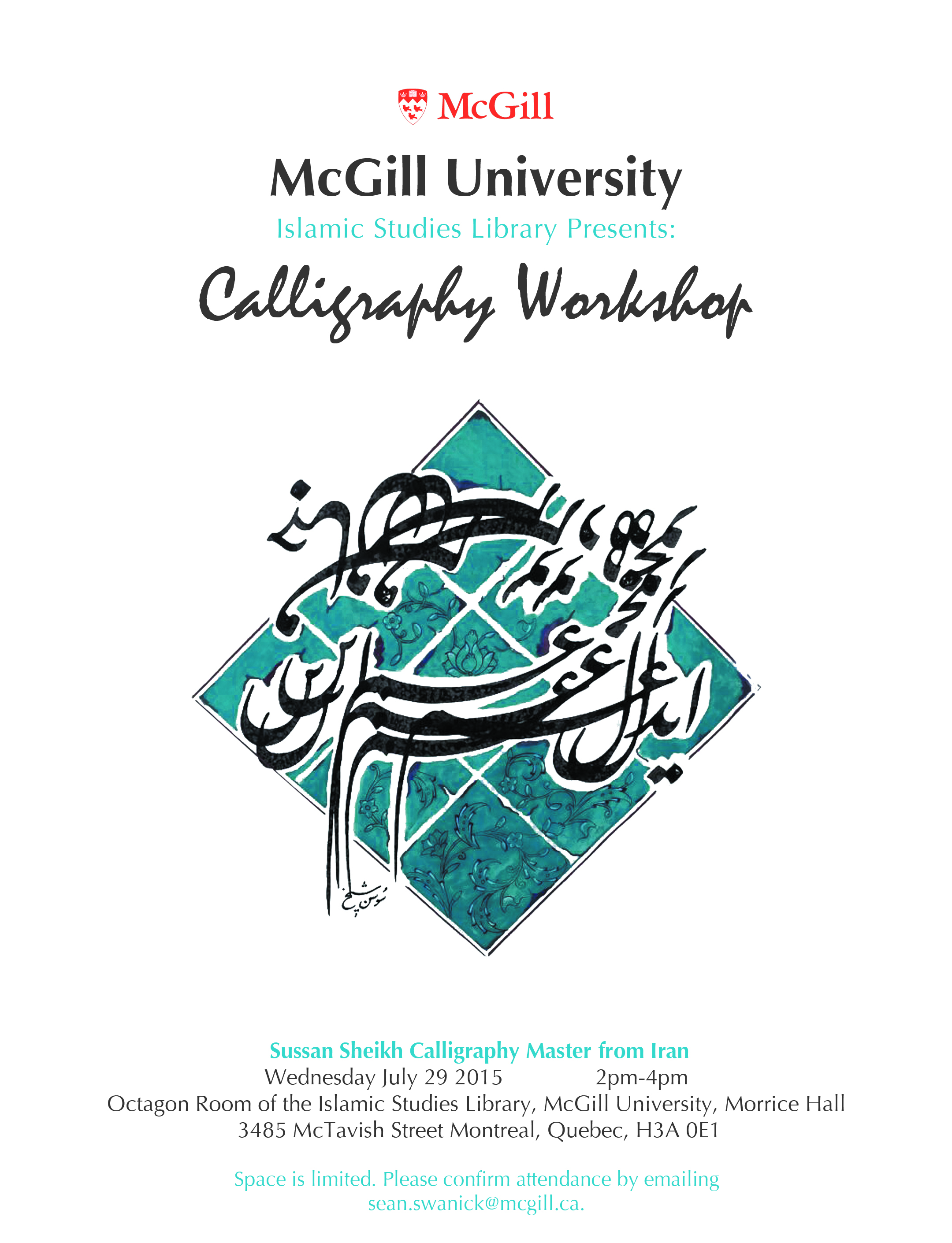
The Islamic Studies Library at McGill will be holding a calligraphy workshop with Iranian calligrapher Sussan Sheikh on July 29th, from 2-4pm in the Octagon Room. Sussan Sheikh studied with Abdollah Foradi and Yadollah Kaboli in Iran in the 1980s, and received the rank of "excellent" from the Anjuman-i Khushnawīsān-i Īrān in 1988. (Reposted from the Islamic Studies Library: http://is.gd/v0Gas3.)
Wednesday, July 22, 2015
Thursday, July 16, 2015
Frances Pritchett's Visit to Montreal
Beginning last week, Columbia Professor Emerita of Modern Indic Languages Fran Pritchett visited my gharīb-khānah in Montreal. Fran is a dear friend, my former PhD adviser, and the creator of the online dīwān of Ghālib, A Desertful of Roses. I took her around the city, and introduced her to her grand-students David Wong, Geneviève Mercier-Dalphond, Zain Mian, and Jessica Stilwell. Fran enjoyed it very much, for, as she said,
"I can give them whatever advice I like and then go away, and it's up to you to feed them and change their diapers."Below are some photos from her trip.
Tuesday, July 7, 2015
Digital Exhibition from the Islamic Studies Library: The Persianate Literary Heritage
Thanks to Islamic Studies Liaison Librarian Sean Swanick, much of the marvellous Persian Literary Heritage exhibition that graced McLennan Library in 2014 during the 10th biennial Iranian Studies Conference is now available online. The beginnings of our collection of Persian materials pre-dates the creation of the Institute of Islamic Studies and the Islamic Studies Library in 1952. The materials in the Blacker-Wood collection were chosen by the Russian Orientalist Wladimir Ivanow, who also catalogued materials at the Royal Asiatic Society of Bengal.
The digital exhibit includes 6 items from South Asia, including a portrait of the 18th-century Mughal ruler Farrukhsiyar. Then there is MS 53, depicting a young woman in profile with a strikingly curved and thick eyebrow.
This painting is described in Glen Lowry’s unpublished 1977 catalogue as a "Miniature of a Princess" from c. 1650. (See Swanick’s page on McGill's Islamic manuscripts, including catalogues by Adam Gacek, Ivanow, and Lowry). It bears an inscription in the upper right indicating the name of the woman. If we take the third element of the name as a lām-alif in which the alif has absconded, this lady may have been called "Almās Bā’ī"—"Miss Diamond." One imagines that this could as easily be the name of a courtesan or other professional as of a princess, but perhaps Lowry had some reason for so designating her.
Friday, June 12, 2015
Noon Meem Rashed Archive - Expression and Reach, a translation by Safdar Mir and N. M. Rashed
Work on the Noon Meem Rashed Archive goes on apace. The second substantial post is on Safdar Mir’s translation of Rashed’s poem "Izhār aur rasā’ī," which was corrected by Rashed and sent by him to the American poet Carolyn Kizer, who later published her own rendering in her anthology Carrying Over.
You can read the post here: Expression and Reach — Translation by Safdar Mir & N. M. Rashed.
Saturday, May 30, 2015
Sufism 2015
This Fall term I will be teaching one of my favourite classes, ISLA 330 Islamic Mysticism: Sufism. At present this introductory Sufism class is full, but there is always the possibility that students will drop out or that the cap will be raised if there are students on the waitlist who want in.
'This class will introduce students to the theory, practice, and history of Sufism, often referred to as "mystical" Islam. We will consider the emergence and efflorescence of Sufi orders throughout the world, from the Middle East and Iran to South Asia, China, and South-East Asia, and from Africa to Europe, Britain, and Canada. Sufi poetry will be read as well as experienced in the form of qawwali and other musical genres. The underpinnings of metaphysics and ontology will be represented by theoretical works by Ibn 'Arabi, known as the "Greatest Master" (Shaikh al-Akbar). We will look at distinctive ways of reading the Quran, at divine love, infidelity, and the social deviancy of dervish orders. The perceived danger of Sufi beliefs and practices and the consequences of such antipathies will be discussed and debated, from the martyrdom of Hallaj for his scandalous announcement, "I am the Real," to the bombings of Sufi shrines by Islamist groups in the present.'Wednesday, May 27, 2015
Intermediate Urdu 2015-2016
As the poster says…
"Building on Introductory Urdu, this course will improve students' ability to speak, read, understand and write the Urdu-Hindi language۔ Students have the option to write all assignments in the Hindi script; a full Hindi version of the textbook is available. Teaching involves in-class activities, conversation, and lessons, as well as homework exercises and tests. By the end of the course students will have a grasp of the full range of Urdu-Hindi grammar. Students will be familiarized with aspects of South Asian culture connected with the language, and will be exposed to Urdu-Hindi poetry and film. Students from outside of McGill are welcome to take this course through CREPUQ. Please email the professor for further information."
The image is from the Satyajit Ray film, Shatranj ke khilāṛī, an exquisite treatment of the fall of the state of Awadh at the hands of the British. Hopefully by the end of the course students will have learned enough Urdu to understand the dialogues.
Sunday, May 24, 2015
Origins
In some form or another, South Asia and the Urdu language have been studied at McGill at least since 1952, the year of the founding of the Institute of Islamic Studies by Wilfred Cantwell Smith, who had formerly taught at Forman Christian College in Lahore (then part of British India). More than 60 years have now passed since the founding of the Institute. But it has been only three years since I came here—and yet I have already discovered that there is a great deal here to share in terms of archival documents, teaching resources, and Urdu/South Asia-related happenings at McGill.
Some part of this is already covered by the new blog highlighting the amazing N. M. Rashed Archive donated by Yasmin Hassan, highlights from which will be shared here as well. But I realized after looking through the papers of Prof. Abdul Qavi Zia, the Urdu lithographs and more recent books at the Islamic Studies Library, and some items in my own collection, that I would need a wider-ranging academic blog. Hence Tilism.
Subscribe to:
Posts (Atom)


